
· Hub for the NS Community ·

Dear community members,

Together with NSX, the VivaHub project will launch a mobile health kiosk which brings support and prevention directly into the neighborhood.
VivaHub builds upon the foundations of the original Health Kiosk, operating from a broad perspective on health. The focus isn't just on mental and physical well-being, but also on other themes such as housing, employment, and social connection. With the Mini-kiosk, VivaHub can maintain a flexible presence in various locations, making it even easier to support and empower people at a local level.
NSX plays a vital role in this mission. Through Zipster, local care and welfare services are made digitally accessible, ensuring that neighborhood-level needs are translated into concrete support options. In this setup, the VivaHub Mini serves as a physical gateway to a digital ecosystem where human-centered work and technology reinforce one another.
The Mini-kiosk will officially launch on Thursday, March 19. The next step in the digital phase will be taken soon with the launch of a conversational layer on top of Zipster. This layer will allow users to navigate local services in a more natural and context-sensitive way. We look forward to sharing more details about this in our next newsletter.
If you would like to attend the launch event, please register individually using this form: 👉 Vivahub Google Form
To learn more about VivaHub or the roles of NSX and Zipster within this project, you can always contact Stijn Coolbrandt .

As the pioneers of Normalized Systems (NS), we are always looking for ways to bridge the gap between architectural theory and automated enforcement of our core principles. Building on the Paper of Kris Ven (2010) describing systems to automatically identify violations of the Normalized Systems (NS) design theorems. While that foundational work had some good ideas, it also had its limitations. As with any automatic validation tool, the primary challenge is how to avoid flagging too many false positives or irrelevant cases.
We have expanded on this idea with additional checks, trying to catch as many of the violations against each theorem as possible. The checks run on an abstract syntax tree generated from the parsed source code. Analysis is enriched with information retrieved from the git history.
To ensure the output is actionable, the issues are tallied to give a 'risk' score to each file in the repository. We use a weighted model to prioritize impact. Issues are weighted based on how often the functionality is used. For example, methods that are used everywhere outweigh methods that are only used once. Files with a score above a certain threshold are flagged as 'problematic'. Results are presented with the highest score first.
This system provides developers with a clear guideline on how to best start improving their code, ensuring that refactoring efforts are directed where they provide the most value.
Ready to tackle the technical debt in your system with precision? Contact us for a demo of our validation engine and discover how we can provide a concrete action plan for a future-proof architecture.

Helicus is organizing a brainstorming session focused on how hospitals can benefit from automated drone transport, including a dedicated live demonstration of automatic drone handling of medical packages. All this is powered by normalized systems software of NSX.
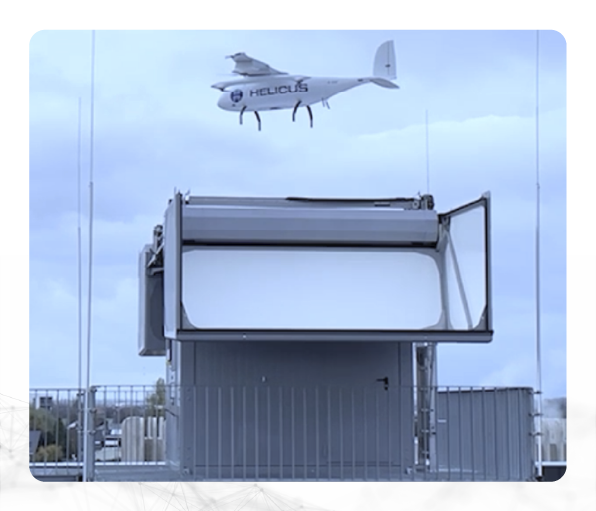
This afternoon session will showcase how fully automated drone cargo logistics has already been implemented in a real operational hospital environment. At the core of this modular ground automation architecture is the Helicus Drone Cargo Port (DCP), which connects automated drone flights with fully automated ground cargo handling and extends automation directly into buildings through bi-directional integration with pneumatic tube systems.
Having been developed for healthcare logistics, the solution is implemented in an operational hospital environment (Ieper and now Liège). The technology addresses key challenges such as time-critical transport, automated sample flows, hospital rooftop operations and integration with existing healthcare logistics infrastructure (incl. pneumatic tube post). The same principles are increasingly relevant for industrial environments requiring secure, reliable and scalable logistics solutions.
The session will combine expert insights, regulatory perspectives, interactive discussions and a live flight demonstration of the Helicus Drone Cargo Port at DronePort, Sint-Truiden. Participants will be able to physically visit this infrastructure that can be integrated into their own operations.
This event takes place on 24 February 2026, from 14:00 to 18:00, at DronePort in Sint- Truiden. Should you be able to attend, register via link: Healthcare/industry.
We would be delighted to welcome participants and exchange views on the future of automated drone cargo logistics in medical, pharmaceutical, and industrial contexts. Please find attached the formal invitation that you may use and distribute amongst interested parties. Invitation
